


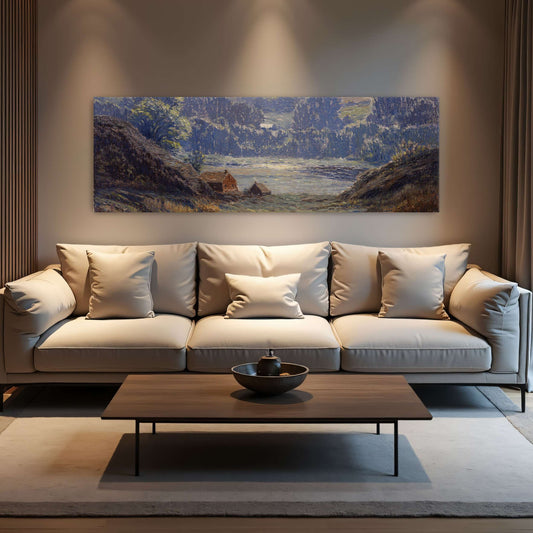
Choosing hallway wall art by shape
Hallways and foyers present specific spatial challenges. You view prints up close while walking past them, which makes strong compositions and clean lines essential. This collection organizes hallway wall art into two functional formats: panoramic horizontal prints for long walls and tall vertical prints for narrow spaces.
A long horizontal wall benefits from a panoramic piece that mirrors the hallway corridor. For narrow wall sections between bedroom or closet doors, tall portrait prints fill the vertical space without crowding trim or light switches.
| Wall or furniture width | Suggested print | Price |
|---|---|---|
| Narrow wall, 24 to 36 in | 16 × 24 in tall portrait | $60 paper / $100 canvas / $150 framed |
| Console table, 40 to 48 in | 24 × 36 in tall portrait | $80 paper / $140 canvas / $180 framed |
| Hallway wall, 5 to 6 ft | 12 × 36 in panoramic | $120 canvas / $150 framed |
| Long hallway, 7 to 8 ft | 16 × 48 in panoramic | $160 canvas / $220 framed |
| Open wall, 9 ft or wider | 20 × 60 in panoramic | $200 canvas / $250 framed |
For more sizing advice across rooms, consult our Wall Art Size Guide.
Hanging art in a hallway
On an open hallway wall, center the art about 57 inches from the floor to match eye level. When hanging a row of identical prints, maintain 2 to 4 inches between frames as a rule of thumb. This spacing keeps the display cohesive without feeling cluttered.
Always verify clearance before hanging. Keep frames clear of door swings, coat hooks, and light switches. Hanging wire comes pre-installed on framed canvas prints, and using two wall hooks keeps wide frames level over time. Read our guide on How High to Hang Art for detailed step-by-step measurements.
Entryway wall art and console tables
An entry sets the tone for your home. While many homes feature a mirror, entryway wall art offers rich color and a welcoming visual anchor. When hanging art above a console table, choose a print about two thirds the width of the table. Leave 6 to 10 inches between the top of the console and the bottom edge of the frame. This positioning connects the artwork visually to the furniture beneath it.
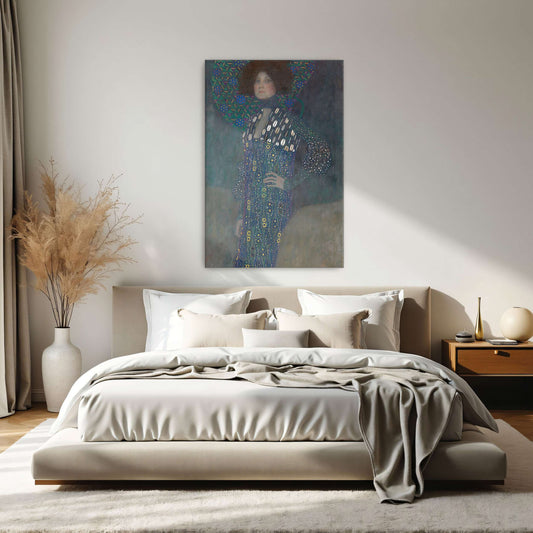
Full-length portraits work well beside an entry bench or coat rack. Gustav Klimt created Woman in Long Blue Dress (Emilie Flöge) in 1902, capturing intricate patterns and cool blue tones. For floral color on a small wall, consider Delphinium (circa 1915) by Hannah Borger Overbeck.
Landscape and architectural themes
Horizontal corridors pair naturally with wide scenic vistas. Carl Moll painted Heldenplatz with Lilacs in 1900, showing soft spring foliage along an urban walkway. Jan Stanislawski captured expansive open skies in Cloud over the Dnieper River (1903).
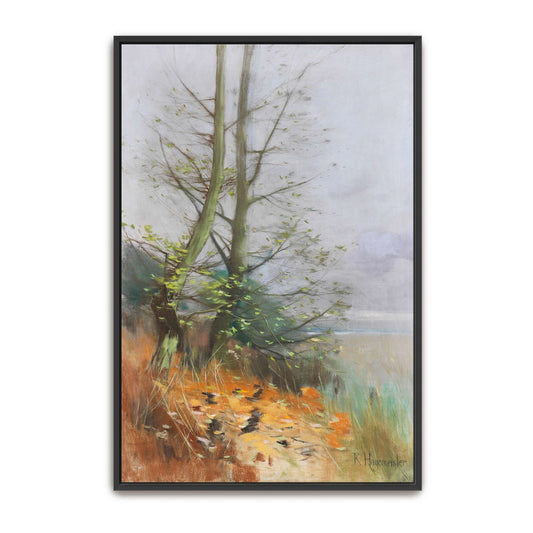
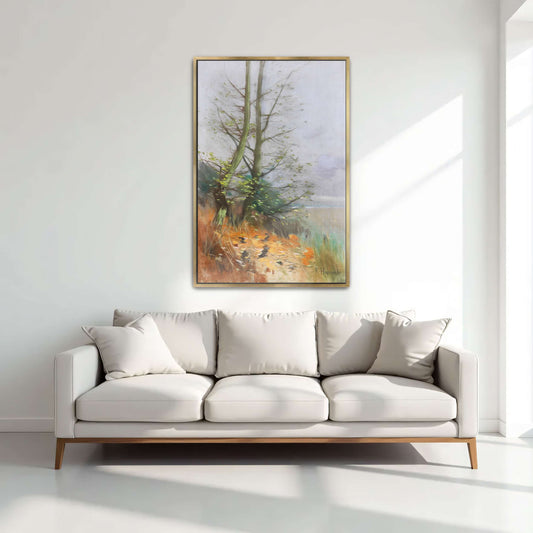
Vertical landscape views fit narrow nooks between doorways. Karl Hagemeister depicted slender trunks in Birches in Autumn by a Stream between 1908 and 1913. For modernist spaces, Paul Klee used structured grids in Geometric City (Polyphonic Architecture) (1930).
Materials and framing options
Our canvas prints use thick, acid-free archival canvas hand-stretched on solid wood bars. The giclée printing process provides 100 or more years of fade resistance. Framed canvases sit inside floating wood frames, while unframed gallery wraps feature pre-installed sawtooth hangers. You can read our guide on Canvas vs Framed Canvas vs Fine Art Paper to compare each finish.
Explore related art
Explore wider vistas in our Panoramic & Horizontal Wall Art collection. View classic outdoor scenery in Vintage Landscape Paintings. For Austrian Secessionist styles, browse Gustav Klimt Prints. You can also discover nature studies in Vintage Botanical Prints.